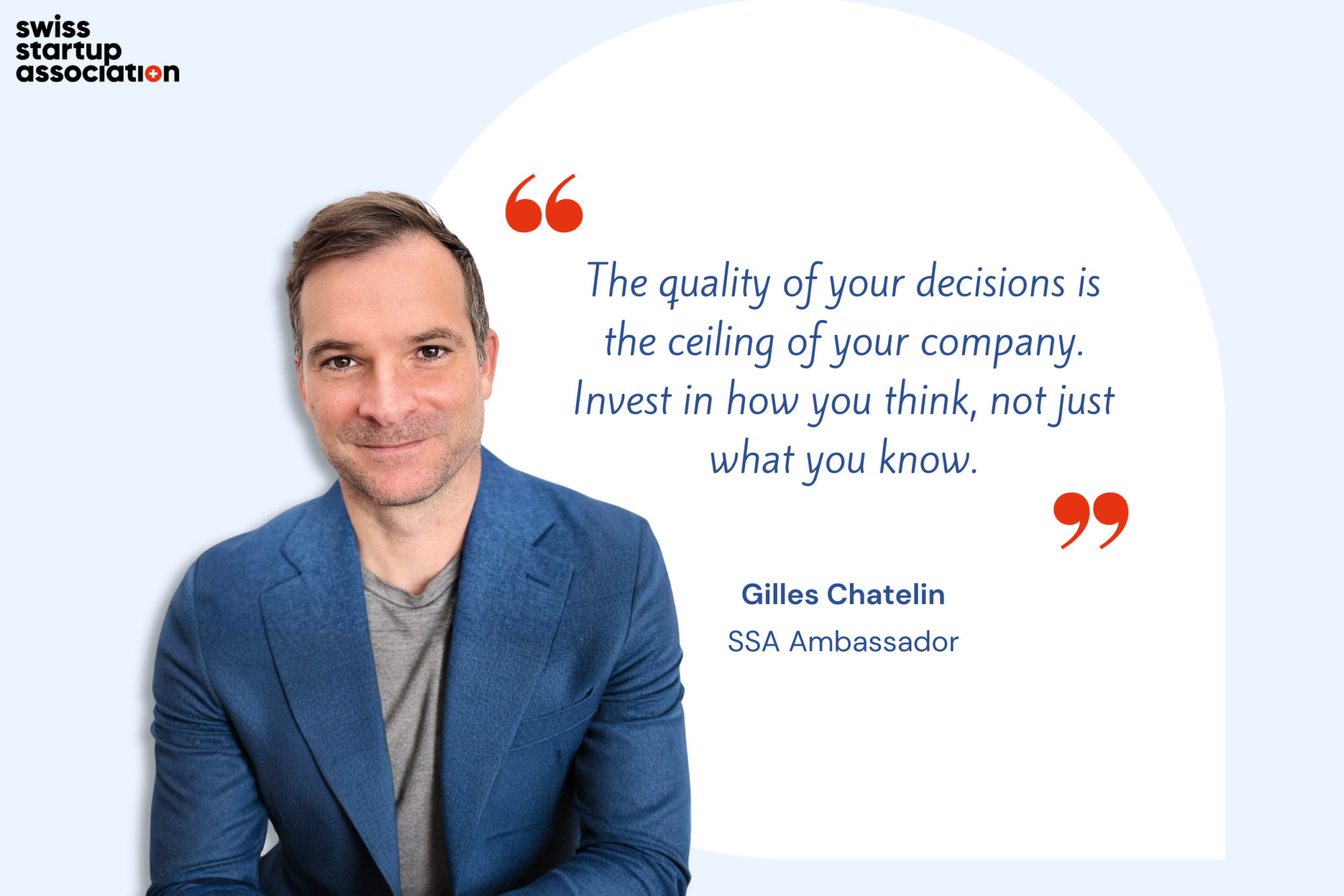
Meet our Ambassador Gilles Chatelin
Please tell us more about yourself.
For 20 years, I sat across the table from people whose job was to beat me on deals worth hundreds of millions of dollars. I led global negotiations for multinational corporations in pharma, tech, and defence. Outside work I raced Ironman triathlons and ultra-endurance events. Both taught me the same thing about pressure: that it exposes your true character.
Now I work with founders and CEOs at the point where scaling starts breaking something. The team, the co-founder relationship, often the founder themselves.
Most coaches ask how that makes you feel. I ask what you’re going to do about it, and whether you can actually pull it off. That’s a different job.
Which sectors, technologies, or topics drive your interest in the startup ecosystem?
Deep tech, climate, physical AI, and life sciences. Switzerland’s best fields, and the ones where the technology outruns the person running the company.
But beyond sectors, what I care about is the founder and how the team performs together. The exact moment a brilliant builder has to become a CEO and realises those are two different jobs. Nobody prepared them for the second one. That’s my work.
Can you share a success story or a highlight of a startup you’ve been closely involved with?
The honest answer is I can’t give you the one everyone gives. No logo, no “they raised X million.” My work is confidential, and the wins that matter don’t show up in a funding announcement. So here’s a real one, disguised.
Two co-founders, post-Series A, hadn’t had a real conversation in months. On the surface, it looked like a strategy fight. Underneath, one felt the other had checked out the day the money landed, and neither would say it. The company was splitting in half while both told the board everything was fine.
That’s the pattern. The shareholder agreement is where it ends up. The real break happened months earlier, in the stuff nobody would say out loud. And when a lawyer’s involved, you might feel that you are fixing it, but essentially you’re just dividing the estate.
My job was to get them to say the thing they’d both been avoiding. That’s a rough hour to sit in. They’re still building together today. And these moments don’t get a press release. It’s just the difference between a company that survived and one that didn’t.
What do you think are the biggest opportunities and challenges for Swiss startups today?
Everyone repeats the same thing. Great science and technology, top 10 universities in the world, great capital, but weak on the human side. True. Now it’s just wallpaper. Here’s what’s actually going on.
The early money is taken care of. Series A hit a record in 2025. The wall is growth stage, where the capital is mostly foreign. So the day a Swiss founder raises to scale, the job flips overnight. They get a foreign board and even relocation pressure. Decisions at a speed that our culture punishes.
And underneath all of it sits something profoundly cultural. In the US, a founder who blew up a company is experienced. In Europe, they’re damaged goods. So everyone here optimises to avoid failure, which is exactly backwards. Failure isn’t a motivational poster. It’s biology. You adapt by breaking and losing, or you don’t adapt at all. The ecosystems out-scaling us, Israel first, are the least frightened of it. Is that a coincidence? A founder who’s never failed hasn’t been tested. They’ve only been very lucky.
If you could share one piece of advice with startups and entrepreneurs, what would it be?
The quality of your decisions is the ceiling of your company. You can’t hire around it.
What inspired you to become an SSA Ambassador, and how do you hope to contribute?
Switzerland’s finally admitting it has a scaling problem. Good. Now everyone’s rushing in to fix it, with funds, programmes, accelerators, peer circles, communities, etc. That’s all well and good, but most of it stays at a safe distance from the people actually running the company. I work the opposite way. In the room with the founder or the founding team, when the decision’s due and it’s going against them. SSA reaches those people and doesn’t flinch at hard truths. That’s why I’m in.
How do you envision the future of the Swiss startup ecosystem, and what role would you like SSA and its Ambassadors to play in it?
Switzerland will keep building great companies. Whether it keeps them is the real question. Last year, 31 Swiss startup exits went to foreign buyers. Only 10 stayed in Swiss hands. To me that’s a leadership problem as much as a money one.
We need more people who’ve operated at scale getting close to founders. Not handing down wisdom from a board seat twice a year. If SSA Ambassadors are operators in the room instead of names on a slide, this ecosystem changes. If we’re decoration, nothing does.
What value do you see in being part of the Swiss Startup Association?
Proximity to real builders, and far less theatre than most networks. It keeps me on live problems instead of theories about them. And it puts me in front of the founders I can actually help. That’s the whole reason I’m here.
Is there anything else you would like to share with us?
You didn’t ask why I left corporate.
Twenty years in big corporations taught me that large organisations reward the people best at managing perception. Startups reward the people who see the thing clearly and say it. Two years ago I found out I’m neurodivergent, and that I always have been. It explained a lot. My whole career I’d been the one in the room naming what everyone else was tiptoeing around. In a corporation, that made me difficult. With founders, it’s the whole point.
Connect with Gilles on LinkedIn!
-
Author
info@swissstartupassociation.ch -
Published
18.05.2026 -
Category
Main -
Share on Linkedin
-
News
Other, related articles you may like