Qatar: A Launchpad for Swiss Startups
Swiss founders know what it means to start small, and most look first to Germany, France or the United States when they go international. The Gulf rarely makes the shortlist, and Qatar, with around three million inhabitants, even less so. That assumption deserves a second look. Qatar’s appeal is not its size but what it gives a small team: decision-makers a short drive apart, investors with more capital than deals, and a bridge into the wider Gulf.
That was the core message of a recent webinar hosted by the Swiss Startup Association in partnership with Switzerland Global Enterprise (S-GE) and the Swiss Business Hub Middle East, ahead of Web Summit Qatar 2027. Suhail El Obeid, Senior Consultant Middle East at S-GE, and Sarra Messaoudi, Economic and Commercial Officer at the Embassy of Switzerland in the State of Qatar and Swiss Business Hub Middle East – Qatar, were joined by Bilel Al Souaied, advisor at Swiss venture capital firm Redalpine, and Indica Amarasinghe, Chapter Director of Startup Grind Doha.
Their advice for Swiss startups came down to three lessons: use Qatar as a launchpad rather than a destination, move while capital still outnumbers the deals, and build relationships long before you need them.
Treat Qatar as a Test Bed, Not a Customer Base
Al Souaied did not oversell the market. “It’s not a lot for a consumer base,” he said of the population. “But it’s an amazing launchpad.” The reason is density: Doha’s West Bay area puts government, energy companies, leading hospitals and a global airline within roughly 20 square kilometres. In Europe or North America, reaching such a range of design partners and first customers is slow and expensive. “It will burn through an entire pre-seed or seed round,” Al Souaied said. For a Swiss B2B or deep tech startup, a few focused weeks in Doha can produce meetings that would take months to line up elsewhere.
But a launchpad is not a passport. There is no unified regulatory regime across the Gulf, Al Souaied stressed, so an approval in Qatar does not carry over to Saudi Arabia or the UAE. Within Qatar, the jurisdiction matters too: the Qatar Financial Centre, the free zones and Qatar Science and Technology Park suit different business models. Full foreign ownership is possible in many sectors, Messaoudi added, but not in areas such as insurance or energy.
The lesson for founders is simple: plan Qatar as the first step of a regional strategy, and budget for separate regulatory work in every market that follows.
Move While Capital Outnumbers the Deals
Qatar’s ecosystem is young but changing quickly, Messaoudi explained. The state is diversifying away from oil and gas, and its priority sectors map closely onto Swiss strengths: AI, fintech, healthtech, climate tech, cybersecurity, robotics and IoT.
The bigger shift is in funding. The Qatar Investment Authority is now bringing venture capital expertise into the country rather than only financing startups directly. Its fund-of-funds programme has grown from USD 1 billion to USD 3 billion, and international VCs that joined it have set up in Doha since 2025. According to Amarasinghe, a dozen VC funds now operate through the programme, while family offices are shifting money from construction into startups and several public bodies offer deep tech grants.
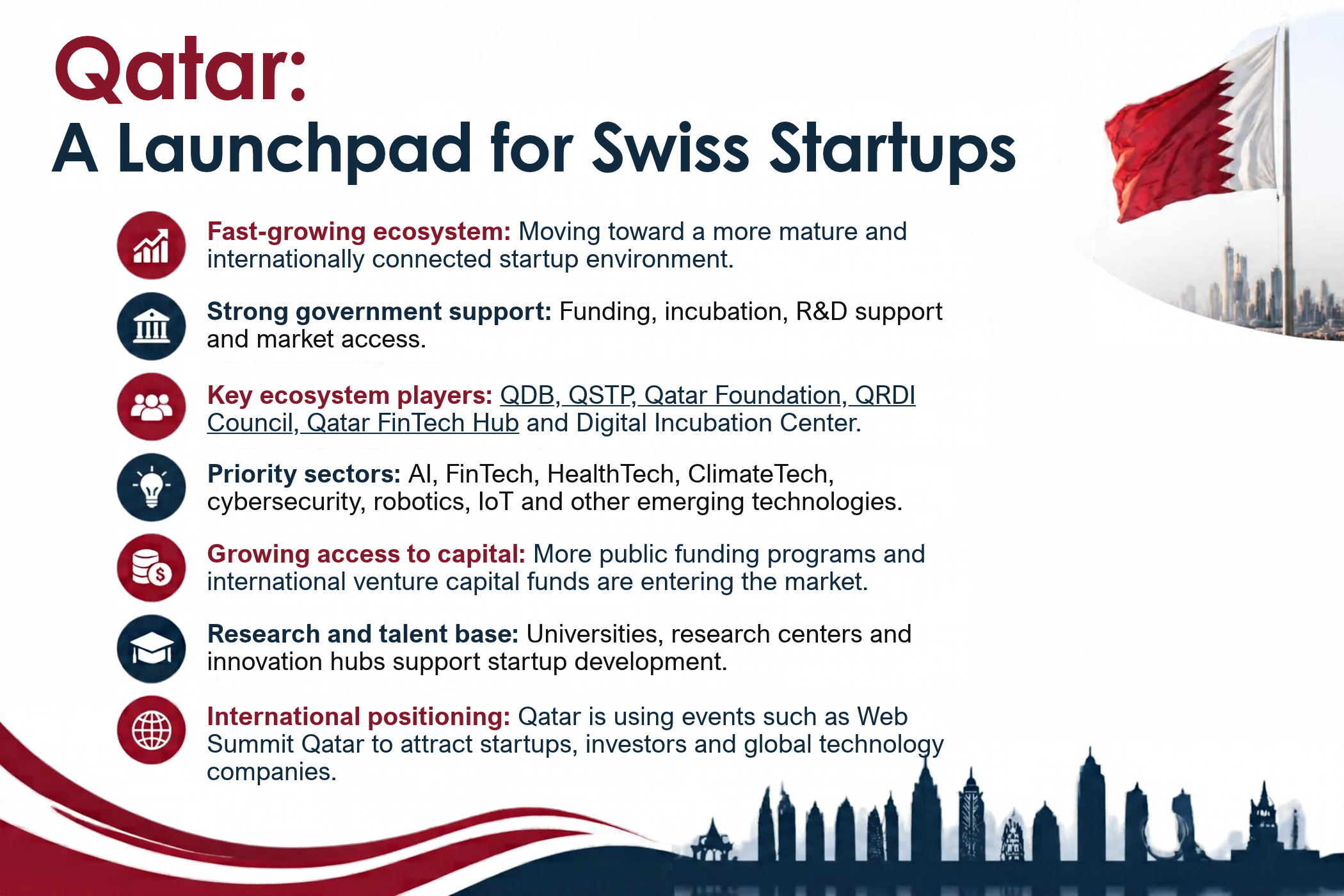
Qatar’s startup ecosystem at a glance: government support, priority sectors and growing access to capital. Source: Swiss Business Hub Middle East.
Al Souaied summed up the result: for now, the capital dedicated to startups exceeds the number of companies coming through. “So it’s relatively easier to get in front of investors,” he said. For Swiss founders used to competing for attention in Zurich or London, that is a real opening. But such windows narrow as ecosystems mature, and the founders who benefit most will start conversations while investors are still looking for deals, not when they urgently need a round.
The Summit Opens the Door. Relationships Keep It Open.
Many questions from participants came back to one problem: how do you reach the right people? When one founder asked how to sell AI services to family offices, Messaoudi’s answer was direct. “You cannot knock on the door and go to family offices. You need to have a good product to present, at least for them to accept you for a meeting.” In the Gulf, business moves through networks: choosing the events your audience attends, being seen more than once and relying on warm introductions.
Web Summit Qatar helps by bringing the region under one roof, and corporate executives there tend to be open to conversations, Al Souaied noted. Nobody will set those meetings up for you, though. “It’s up to the founder to actually go and find who suits them best,” he said. Many valuable side events are also restricted by profile: investor, startup, family office or LP.
Amarasinghe raised the question most founders forget to ask: “The whole world comes into Doha. What’s next?” His answer is the local community. Startup Grind Doha has more than 4000 members, around 80 per cent of them based in Qatar, and has run 26 events this year alone. That is where trust gets built after the exhibition halls close.
Key Takeaways for Founders
- Treat Qatar as a launchpad for B2B pilots and regional expansion, not as a large consumer market.
- Use Doha’s density to meet design partners and first customers faster and more cheaply than in Europe.
- Start investor conversations now, while capital in Qatar still exceeds the number of startups seeking it.
- Get regulatory advice for each Gulf market separately.
- Arrive at Web Summit Qatar with a target list and a side-event plan, and follow up locally afterwards.
Final Thoughts
Swiss founders have an advantage they rarely notice: they already know how to grow from a small, wealthy and tightly connected home market. Qatar works on a similar logic. Its value lies in access, not volume. What it asks of them is different, though. Swiss business culture often trusts the product to speak for itself. In the Gulf, the relationship usually comes first, and the product earns the second meeting.
That is not unique to Qatar. Every new market rewards founders who keep showing up once the event is over. Web Summit Qatar lasts four days. The relationships Swiss startups build around it could shape the next five years.
About the Webinar
This article is based on the webinar Exploring the Qatari Market: Getting Ready for Web Summit Qatar 2027, hosted by the Swiss Startup Association in partnership with Switzerland Global Enterprise (S-GE) and the Swiss Business Hub Middle East on 28 September 2026. Suhail El Obeid, Senior Consultant Middle East at S-GE, Sarra Messaoudi, Economic and Commercial Officer at the Embassy of Switzerland in the State of Qatar and Swiss Business Hub Middle East – Qatar, Bilel Al Souaied, Advisor at Redalpine, and Indica Amarasinghe, Chapter Director of Startup Grind Doha, discussed Qatar’s startup ecosystem, its investors and how Swiss startups can prepare for Web Summit Qatar, held in Doha from 31 January to 3 February 2027.
The full webinar replay is available in the Swiss Startup Association Education Library, free for members. Not a member yet? Join the community and get access to expert sessions like this one.
Subscribe to our newsletter to hear about upcoming webinars and events.
News
Other, related articles you may like