Entering the Indian Market: A Guide for Swiss Startups
For many Swiss founders, going international means Europe or the United States. India rarely makes the shortlist, and when it does, it is often seen as a place for low-cost production rather than a market in its own right.
That view is becoming expensive to hold. India is now the world’s third-largest startup ecosystem, with more than 220’000 officially registered startups, a population of close to 1.5 billion and a government actively funding innovation. For some technologies it offers urgent problems, customers willing to try something new, and the scale to validate a product quickly.
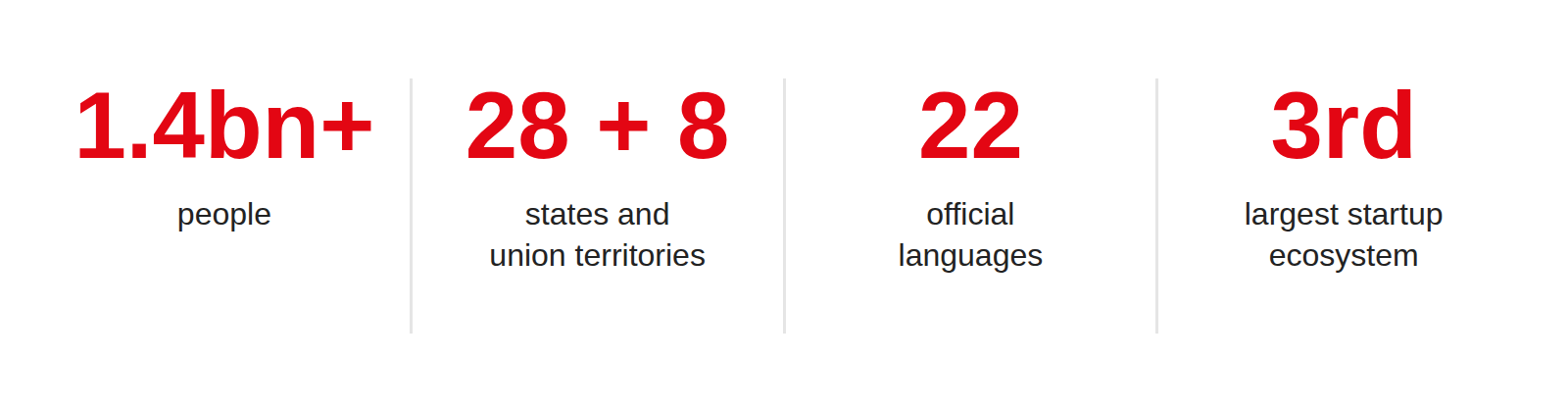
India at a glance. Source: Swissnex in India
In a recent webinar, held in partnership with Swissnex in India, Angela Honegger, CEO and Consul General of Swissnex in India, and Deepika Prithviraj, its Head of Innovation, were joined by Kevin Kleber, co-founder and CTO of SUIND, a drone startup that moved its headquarters from Zurich to Bangalore. Their message was consistent: India can reward Swiss startups, but only if founders are willing to unlearn some of what works at home. Four lessons stood out.
Choose a Region Before You Choose a Strategy
India has 22 officially recognised languages and more than 120 major ones in everyday use. Cities are grouped into tiers by economic status, and the gaps inside a single city can be extreme: in Mumbai, one of the world’s most expensive private homes sits not far from one of Asia’s largest slums. As Honegger put it, “India really can be anything.”
Prithviraj made the practical point: “Success in India often starts with choosing the right region rather than trying to address the entire nation at once.”
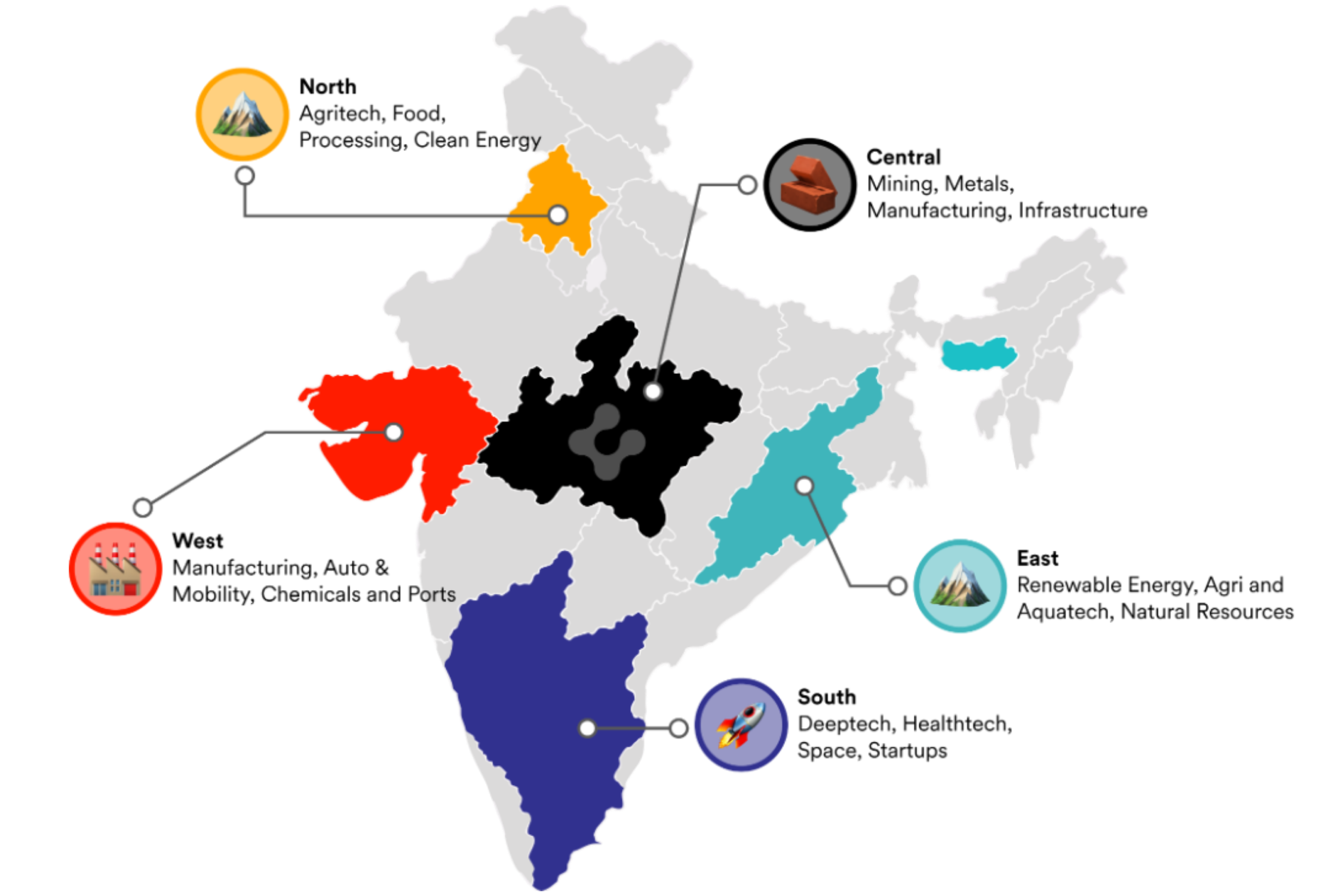
Each region of India has its own industrial strengths, from deep tech and healthtech in the South to manufacturing and mobility in the West. Source: Swissnex in India
A single “India plan” tends to spread a small team too thin, and national averages hide the local realities that decide whether a product sells. The better approach is to pick one region based on your sector, your likely customers and the partners you need, then test your core assumptions there before committing further. That means asking the blunt questions early: is the problem worth solving, will customers pay the price you need, does regulation support your technology, and what has to change in the business model?
Go Where the Pain Is Sharpest, Not Where the Market Feels Comfortable
SUIND did not plan to move to India. Kleber and his co-founder Kunal met at ETH and set out to commercialise drone technology from university research. Their first route to market ran through a partner with customers in Taiwan, in the middle of the pandemic, which left them too far from end users to iterate quickly.
When his co-founder was stranded in India by travel restrictions, the team looked at Indian agriculture and found their assumptions reversed. Drone regulation, still being debated in Europe, was already in place in India and backed by subsidies. Farming happens all year round. And despite the country’s huge population, farms face a real labour shortage as young people move to the cities.
“Europe is quite saturated with technology,” Kleber said. “People expect super advanced products for the first POCs already.” Indian farmers, facing an urgent problem, were eager to try what SUIND had built.
For an early-stage startup, this matters more than market size. Fast feedback is what moves a product forward, and a market with acute pain is far more forgiving of an imperfect first version. It pays to map where your problem is most urgent and where the rules are clearest, and to get as close to the end customer as you can.
The lesson for founders is simple: your home market is not automatically your best test market.
Trust Is Slow, and It Lives in Writing
Kleber was candid about the cultural adjustments. A clear “no” is rare, because people do not want to damage a relationship. Verbal agreements, from investment offers to customer order volumes, were sometimes changed or dropped later. His rule now: “I only assume something is actually going to really happen in the way it was decided once we have it in writing.”
Trust builds gradually. One of SUIND’s leading customers, a large estate in Kerala, started with a small pilot plot, then a larger one, then half the estate. Next year it will cover all of it: in effect, a four-year proof of concept. The customer was happy throughout, but needed time to trust that SUIND would deliver.
The practical consequence is planning. Cash and headcount built around verbal commitments or short sales cycles will come under pressure. It is safer to budget for staged pilots and longer timelines, confirm every commitment in writing, and make it safe for your own team to say “no” and give direct feedback. Warm introductions through incubators, advisers or Swissnex can also shorten the path to a first pilot.
Adapt Your Business Model and Your Fundraising Pitch
India is cost-sensitive and largely built around services. Kleber found that selling an expensive deep tech product takes a lot of convincing, while a service that solves a clear pain moves quickly. SUIND now also offers its drones as a service, with a trusted local lead overseeing operations.
Funding followed a similar pattern. Swiss and European investors were wary of a market they did not know. SUIND eventually raised its first round from investors in Bangalore. The catch: “Most VCs you talk to in India, they really act like private equity, not like VCs.” Even very early-stage founders should expect questions about revenue.
In other words, a business model and a pitch designed for Swiss buyers and investors may not travel. Service or pay-per-use models, strong local leadership and real traction before investor meetings will take founders further than vision alone.
Key Takeaways for Founders
- Treat India as many markets and start with one region that fits your sector.
- Validate pricing, regulation and business model assumptions before committing to market entry.
- Look for markets where your problem is most urgent, not only where you feel most at home.
- Plan for long, staged pilots and get every commitment in writing.
- Consider selling your product as a service in cost-sensitive markets.
- Expect Indian investors to focus on revenue, even at an early stage.
Final Thoughts
The most useful lesson here goes beyond India. SUIND did not find its market through a spreadsheet in Zurich. It followed the pain, stayed close to the customer and changed its model when the market asked it to.
Swiss startups are often built on excellent technology and a culture of precision. Those are real strengths, but they can make founders wait for the perfect product and the perfectly understood market. India asks for something different: patience with relationships, openness to adapting and a willingness to learn in public.
As Prithviraj put it, “Entering India is a journey. It’s not a single decision.” For founders willing to take that journey step by step, the market that feels furthest from home may be the one that teaches them the most.
About the Webinar
This article is based on the webinar “Entering the Indian Market: A Guide for Swiss Startups”, hosted by Swiss Startup Association in partnership with Swissnex in India on 9 September 2026. The session featured Angela Honegger, CEO and Consul General of Swissnex in India; Deepika Prithviraj, Head of Innovation at Swissnex in India; and Kevin Kleber, co-founder and CTO of SUIND, a Swiss-founded drone startup now headquartered in Bangalore. Together, they shared practical insights into India’s innovation landscape, the sectors with most potential for Swiss startups and what it takes to build a business on the ground, including the Innosuisse Internationalisation Camps run by Swissnex.
Watch the full webinar replay in the Swiss Startup Association Education Library, free for members. Not a member yet? Join the community and get access to practical sessions that help you take your startup into new markets.
Stay up to date with upcoming webinars and ecosystem news by subscribing to our newsletter.
News
Other, related articles you may like