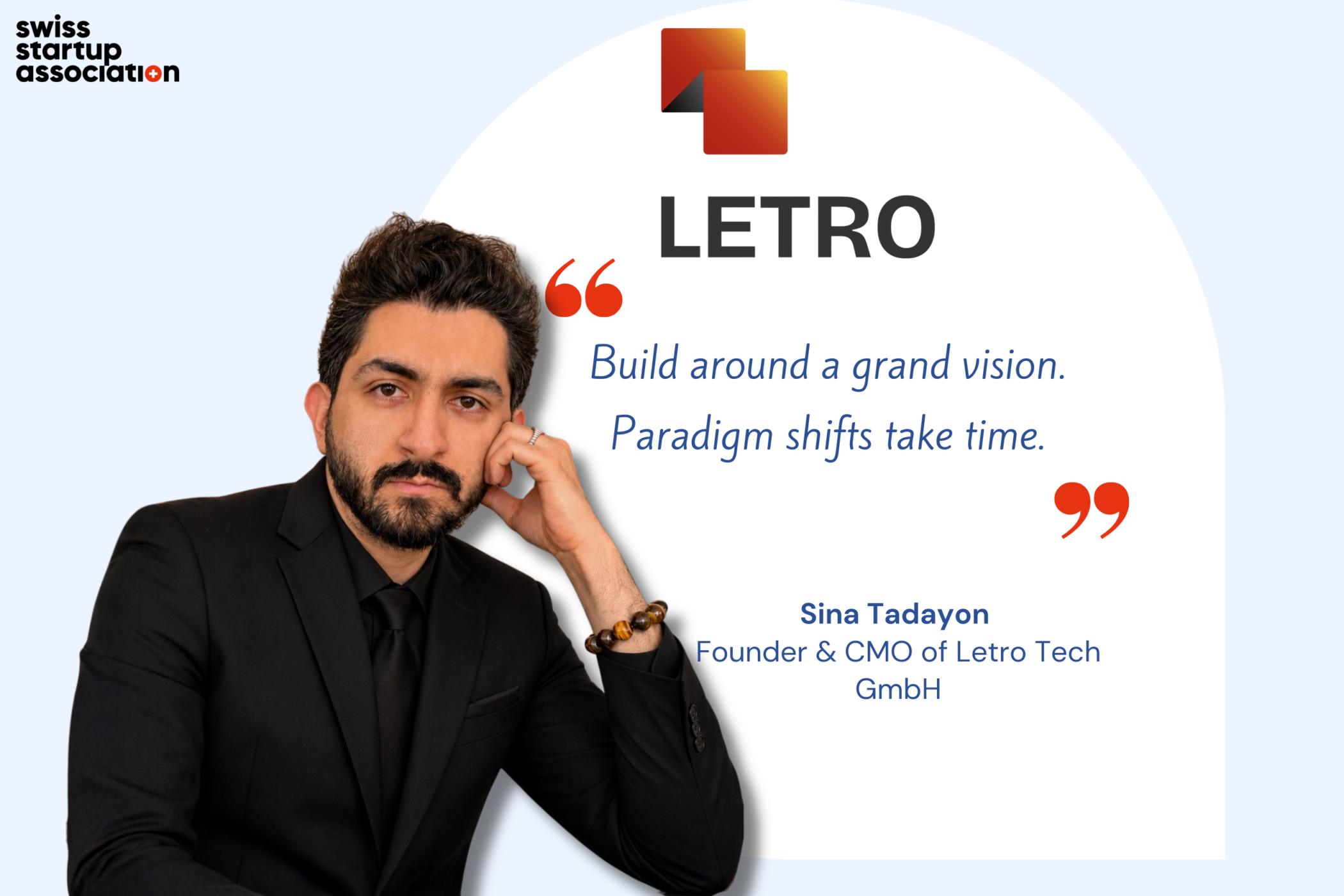
Meet Sina Tadayon, Founder & CMO of Letro Tech GmbH
Tell us more about Letro.
Letro is a secure communications platform for regulated industries and professionals across Switzerland, the EU, and the UK. Launching in Q2 2026, it delivers end-to-end encrypted communication with sovereign data residency, built to meet FINMA, FinSA, and cross-border compliance requirements from day one. The platform is based on audited open-source infrastructure, combining regulatory alignment with technical transparency.
Please give some more details of your startup story: what was the “aha” moment that led to the idea for your startup?
The idea came from my father. He had planned a hiking trip with a close friend to the mountains of British Columbia, but his friend could not join. He was waiting for an important letter from his business bank. My father called me, genuinely puzzled: “Why, in 2024, does a professional still have to wait by the post for a bank letter?” That question stayed with us. The technology already existed. What was missing was a platform built around the compliance requirements of regulated industries from day one, not retrofitted to them later. We decided to fix that.
So, what’s next for you—what’s a bold goal you’re chasing right now?
Our bold goal is to become the default secure communications infrastructure for regulated professionals across European financial centres within five years. To achieve this, we are onboarding founding members, a select group of asset managers and law firms in Switzerland who will shape the platform from day one. The programme offers early access, direct input into product development, and preferred terms.
Which decision had the most unexpected positive impact on your startup?
The most impactful decision we made was one we initially approached as purely technical: building on an open, federated protocol rather than a proprietary stack. We expected architectural flexibility. What we did not anticipate was how deeply this would resonate with our clients’ core concerns. Regulated professionals do not just want security; they want to know that no single entity, including us, has unilateral control over their communications. Decentralisation answers that question structurally, not contractually. It also allowed us to point to independent third-party audits of our core infrastructure from day one, rather than asking clients to trust us on faith. What started as a technical choice became our strongest trust argument.
How did you build your team, and what helps you maintain your startup culture?
The first question I asked when building the team was not “Who is available?” but “Who do I trust completely?” Early-stage startups do not fail because of bad technology; they fail because trust breaks down under pressure. In the beginning, the people closest to you, such as friends or family, are often where that trust already exists. That is an advantage worth using. But trust must also be maintained structurally. From day one, we sat down together and wrote our own code of conduct, not a template from the internet, but our actual commitments to each other. Everyone signed it. That document has proven more valuable than any tool or process we have adopted since.
If you could do it all over again, what would you do differently? What are your biggest learnings?
If I could start over, I would move faster. Specifically, I would implement tight design-build-test cycles from day one rather than treating early development as something that needed to be perfect before being revisited. In cybersecurity, this feels counterintuitive, even dangerous. The instinct is to be certain before shipping anything, because the cost of getting it wrong feels catastrophic. That instinct is understandable but partially wrong. You can run rapid development cycles in a security product. You can test aggressively, iterate quickly, and still conduct rigorous due diligence before final release. Speed and security are not opposites; sequential thinking is the real enemy. Waiting for perfection before testing often leads to less secure outcomes, not more. You find what is broken by moving, not by standing still. The honest answer is that I would have trusted that process earlier.
Building a startup requires resilience. How do you stay focused during tough times?
People often treat recitation as something outdated. I see it differently. Every major tradition builds repetition into daily practice because humans forget. We forget our purpose, our strength, and why we started. I write down my capabilities, my reasons for building Letro, and why tough times are normal and expected. Not slogans, but honest reminders. The moment you stop remembering why you started, fear fills that space. Writing it down and reading it daily creates clarity and steadiness when pressure rises.
One piece of advice for someone who is just starting out with their startup?
What separates humans from every other species is the ability to believe in something that does not yet exist and then build it. Protect that belief fiercely. Strong belief does not make you delusional; it makes you willing. Willing to learn at midnight, to redesign something ten times, to walk into rooms where you feel out of place. Most startup problems are not technical or financial. They dissolve the moment you genuinely believe they can be solved.
What’s your outlook on the future of the Swiss startup scene, and how can it compete internationally?
Switzerland’s startup ecosystem has something many others try to manufacture: global trust. In a time of geopolitical instability and increasing concern about data sovereignty, that is not a soft advantage; it is a commercial one. Regulated industries worldwide are actively seeking alternatives to US-dominated infrastructure. Swiss startups are uniquely positioned to provide that. The challenge is closing the gap between Switzerland’s reputation for quality and the speed and risk tolerance required for international scaling. The opportunity lies in combining Swiss precision with startup agility: move fast, document rigorously.
What value do you see in being part of the Swiss Startup Association?
The Swiss Startup Association provides legitimate exposure and access at a critical stage for founders. The practical value is clear: visibility, resources, education, and investor connections that would otherwise take years to build independently. The deeper value is the reassurance that others have walked this path before. When you start a company, fear is not occasional; it is constant. The Association offers structure, community, and the sense that you are not building alone.
Is there anything else you would like to share with us?
Stop thinking about becoming a unicorn. Not because ambition is wrong, but because valuation is the wrong metric for meaningful work. The world remembers people who changed something real for someone real. You do not need to reach a million people to matter. Find one person whose life is meaningfully better because you built what you built. Build for that person first. If scale comes, it will mean something because of it.

Connect with Sina on LinkedIn!
-
Author
info@swissstartupassociation.ch -
Published
02.05.2026 -
Category
Main -
Share on Linkedin
-
News
Other, related articles you may like