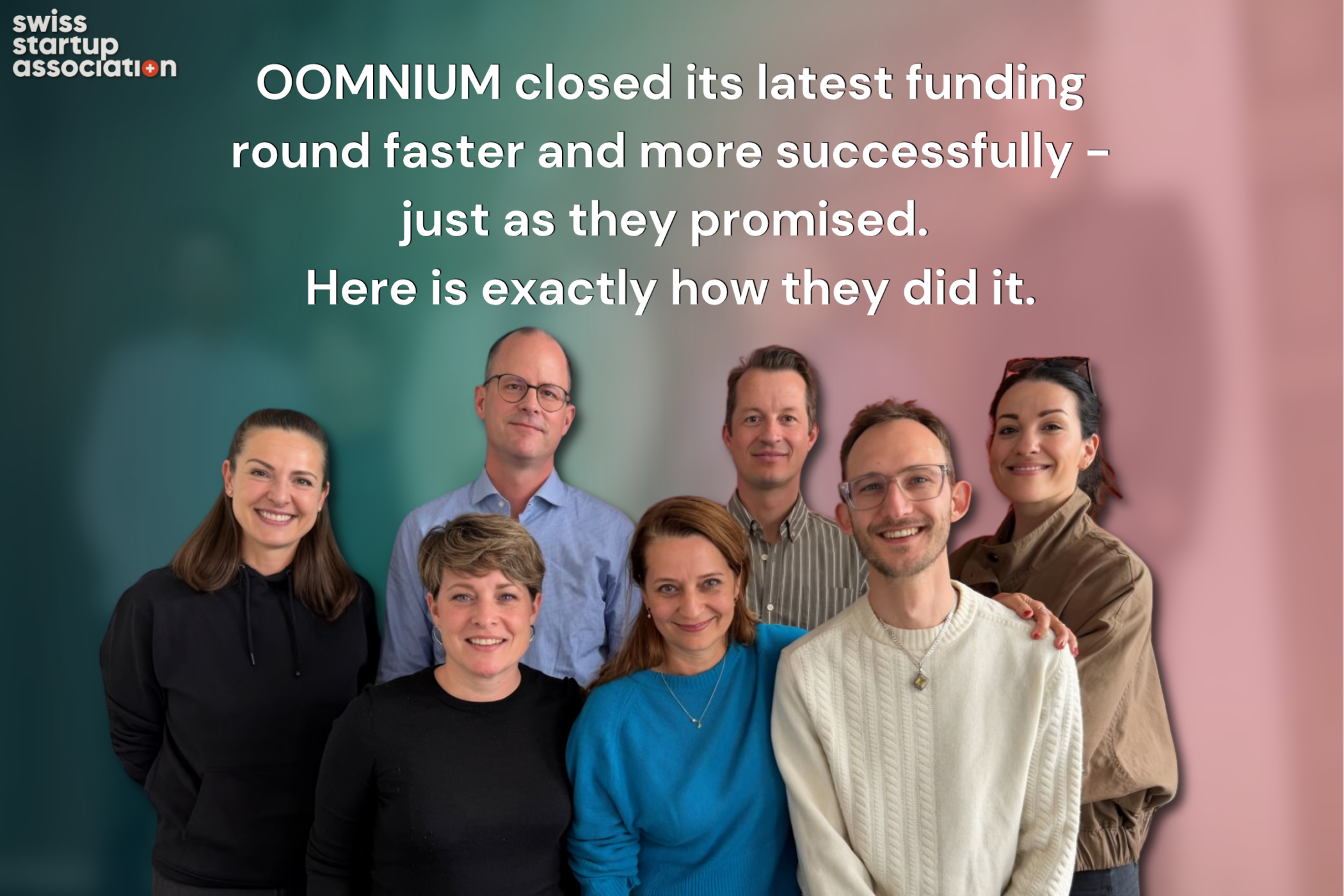
OOMNIUM closed its latest funding round faster and more successfully – just as they promised. Here is exactly how they did it.
At OOMNIUM, the team has built a platform that helps founders raise funds in a lean and cost-efficient way, while giving investors the ability to back exciting startups and SMEs with just a few clicks. When it came time to raise capital for OOMNIUM itself, they decided to apply every principle they preach to their own round.
On March 15, they closed their round: CHF 875,000 in 17 days, 45 percent above their CHF 600,000 target.
The Preparation Phase: Everything Starts Before You Announce
Here is what many founders get wrong: they think the round starts when they announce it. It does not. OOMNIUM’s round started weeks before they told anyone they were raising.
First, they aligned internally. Their team is lean, so getting everyone on board was straightforward. They also made sure all board members were fully committed and engaged from day one.
Then they became methodical. They wrote down every single contact they believed might be interested. They identified “door openers”, people with credibility and networks who could amplify their message. They created a list of potential investors and tracked everything meticulously: who they spoke with, what the level of interest was, what resonated, and what the preferred ticket sizes were.
But here is the critical part: they did not initially talk about the financing round itself. Not yet. They talked about what they had achieved. They gave interviews. They hosted webinars. They remained visible, consistently, across every channel they use. They built momentum before asking for capital.
This activation phase felt like they were raising before they were raising. In reality, they were building the narrative that would make investors want to participate.
The Hot Phase: Structure Creates Opportunity
When they finally opened the round, they did so with precision. They created three distinct phases, each lasting five to seven days.
Phase 1: Highest ticket size with the largest discount. This attracts anchor investors who validate the round and create momentum.
Phase 2: Medium ticket size with a smaller discount. Early traction attracts more participants under slightly different economics.
Phase 3: Smallest ticket size, opened exclusively to a selected group from their platform’s investor base, a few hundred contacts.
Each phase had an explicit funding goal. The team always knew exactly what needed to be achieved. If progress did not align with expectations, they adjusted their strategy mid-way. Transparency within the team kept execution agile.
The short windows created urgency without manipulation. Five to seven days was enough to establish structured scarcity and clear benefits. Investors came to them rather than the other way around.
The Infrastructure That Actually Matters
While many founders underestimate preparation, they often overestimate the importance of the pitch meeting. According to OOMNIUM, the real work happens in communication systems.
They held weekly stand-ups. They maintained shared channels where updates flowed continuously. They sent daily progress updates. Every piece of content published, every interview, every webinar mention, fed directly back into the outreach process. This created constant, coordinated momentum.
The team knew in real time what was working and what was not. They could adapt quickly without losing energy. This avoided the typical fundraising trap of siloed communication and inconsistent messaging.
What They Learned That Applies to You
Preparation is not optional. Before announcing the round, legal documents were ready, funding targets defined, structure locked in, contact lists compiled, and a communication roadmap outlined. The speed of the round was built on months of invisible groundwork.
Focus is a superpower. While raising, they were fully focused on raising. Everything else became secondary. Trying to close a round while launching features, hiring, and managing operational issues rarely works.
They also discovered that networks are deeper than founders often assume. Some of the investors who ultimately committed were not the obvious ones.
Structure proved decisive. Short windows, clear ticket sizes, defined discounts, and explicit funding targets were not minor details. They were the difference between chasing investors and having investors approach them.
Flexibility combined with transparency kept momentum alive. Their plan was not treated as sacred. When something did not work, adjustments were made immediately and clearly communicated.
The Results
They needed CHF 600,000. They raised it in seven days. Two days later, they had effectively reached that amount again and continued raising. Adjustments were made even before phase three began.
Final number: CHF 875,000.
Total time: 17 days.
Two and a half weeks. Then they returned to running the business.
To Every Founder Reading This
For founders preparing to raise capital, the message is clear: the fastest rounds are not necessarily closed by the most charismatic or best-connected founders. They are closed by the most systematic ones. Those who treat fundraising with the same rigor they apply to product development. Those who prepare obsessively, structure deliberately, and communicate relentlessly.
This is the approach OOMNIUM aims to enable for other founders through its platform.
-
Author
info@swissstartupassociation.ch -
Published
02.04.2026 -
Category
Main -
Share on Linkedin