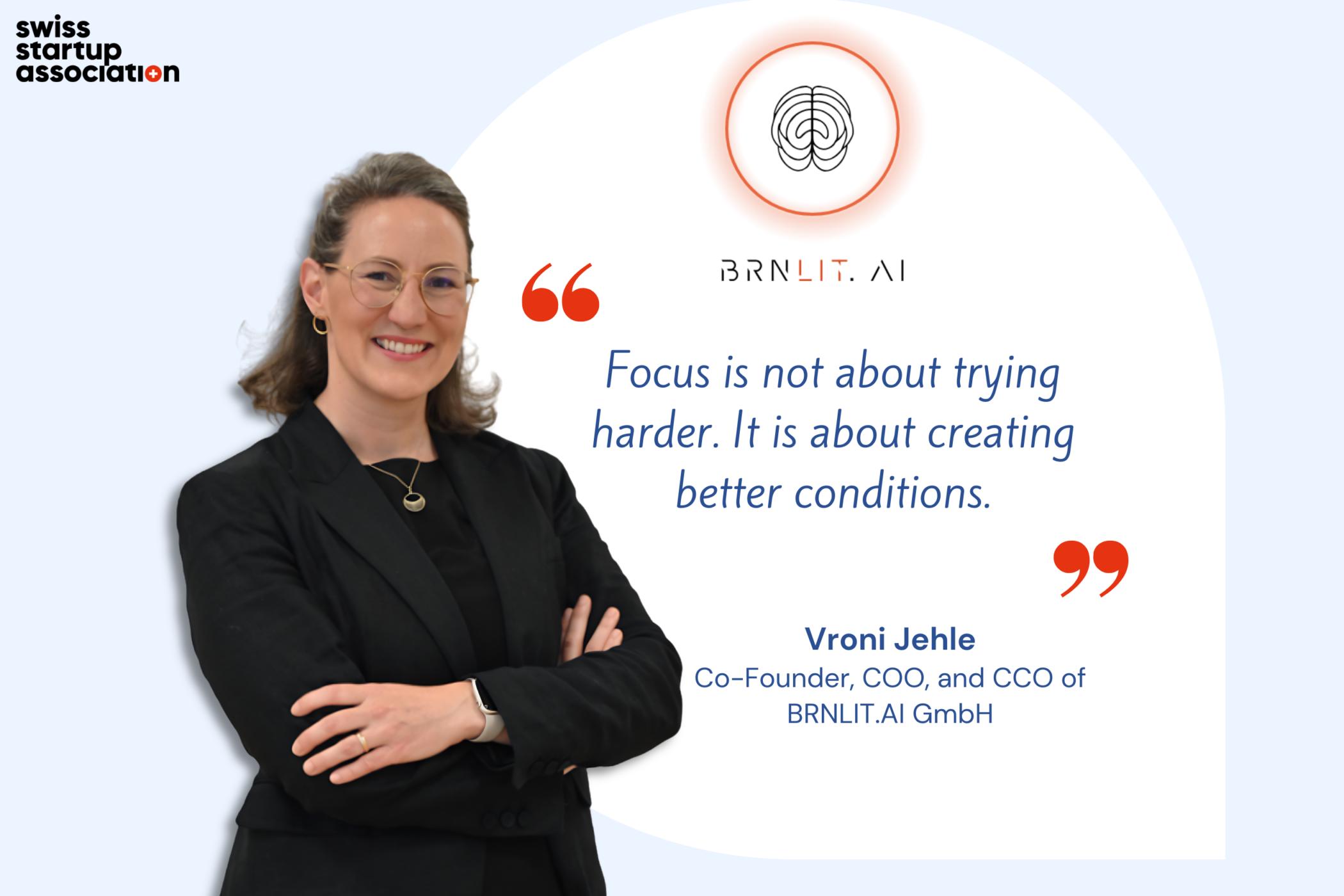
Meet Vroni Jehle, Co-Founder, COO, and CCO of BRNLIT.AI GmbH
Tell us more about BRNLIT.AI
BRNLIT.AI supports people in moments when focus feels difficult to access, for example between meetings, after a long day, or when the mind feels scattered. We translate individual brainwave data into a personalised light signal intended to support focus-related routines. The signal is based on each user’s Peak Alpha Frequency measured via EEG and is delivered directly to the mobile phone, making the personal focus light accessible in everyday situations.
Our core perspective is simple: focus is closely linked to brain states, and these states may be influenced by external stimuli such as light. BRNLIT.AI brings this concept into daily life in a simple and accessible way, helping users create better conditions for focused work and everyday routines.
Please give some more details of your startup story: what was the “aha” moment that led to the idea for your startup?
The idea for BRNLIT.AI started at a moment many people know well: too many responsibilities and not enough focus to match them. During an MBA, while working full-time and raising a family, we came across research exploring how light-based stimulation may relate to brain activity. The thought was immediate: if this is known, why is it not available in a simple, everyday format?
What stood out was not just the science, but the gap. There is a lot we understand about the brain, but very little that translates into something people can realistically use within seconds. BRNLIT.AI was built to close that gap in a responsible and accessible way.
So, what bold goal are you chasing right now?
Our next step is to make personalised focus support more accessible. Today, onboarding still requires a physical EEG measurement. In the future, this may increasingly happen through consumer devices such as headphones.
In parallel, we are strengthening our scientific foundation through planned, structured user surveys and observational studies related to focus experiences and usage patterns. The goal is not just growth, but trust. We want BRNLIT.AI to become a reliable tool informed by scientific research that people can integrate into everyday situations where focus matters.
Scaling access while maintaining credibility and responsible communication is our central focus right now. We are still early in translating emerging research into practical consumer experiences, and we take that responsibility seriously.
Which decision had the most unexpected positive impact on your startup?
One of the most important decisions we made was to keep the product radically simple. In a space like neurotechnology, it is tempting to add more features, more stimuli, and more complexity. We chose the opposite: one clear function and one clear intention — to provide a simple, personalised light experience intended to support focus-related routines.
This simplicity turned out to be a strength. Users understand it immediately and can integrate it easily into their daily routines. It also shaped how we communicate. We prioritise clarity over hype and stay close to what is scientifically grounded. That has helped us build trust early on.
How did you build your team, and what helps you maintain your startup culture?
Our team is built on complementary strengths, but what defines us more is how we work together. We operate with a high level of trust and directness. Ideas are challenged openly, decisions are discussed, and ownership is clear.
At the same time, we are aware that we are building a product designed for situations that involve concentration and cognitive workload. That creates a different level of responsibility in how we develop and communicate our product.
Culture, for us, is not just a set of values on paper. It shows in how we handle uncertainty, how we prioritise, and how we treat each other when things do not go as planned.
If you could do it all over again, what would you do differently? What are your biggest learnings?
We would focus earlier and more strictly. In the beginning, it is easy to explore multiple directions, especially when the technology offers many possibilities. What we learned is that progress comes from clarity, not optionality.
Being more explicit about what we are not building would have accelerated us. We also learned how critical early user feedback is. The closer you stay to real use cases, the better your decisions become.
The key learning is simple: reduce complexity as early as possible.
Building a startup requires resilience — how do you stay focused during tough times?
Staying focused during tough times is less about pushing harder and more about reducing noise. We regularly step back and ask what actually matters right now. That helps us avoid spreading attention too thin.
We also treat energy as a real factor. Rest, perspective, and honest conversations are essential, not optional.
What helps most, however, is seeing real user feedback. Even small moments where users report a positive experience help us stay grounded and continue building.
One piece of advice for someone who is just starting out with their startup?
Start with a real problem that you understand personally. It creates a different level of clarity and commitment. Equally important is how you build your team. Starting with shared values and a clear understanding of how you want to work together makes a significant difference early on. It shapes decisions, communication, and how you navigate challenging phases.
Then simplify relentlessly. Many ideas fail not because they are wrong, but because they are too complex to be adopted. At the same time, build trust early. Be transparent about what your product can and cannot do.
Finally, accept that progress will not feel linear. Staying consistent through uncertain phases often matters more than any single breakthrough.
What’s your outlook on the future of the Swiss startup scene, and how can it compete internationally?
Switzerland has a strong foundation in science, engineering, and trust. This is a major advantage, especially in health and deep tech. The opportunity now is to translate this strength more consistently into solutions that people can use in everyday life.
We see many strong technologies, but fewer that are designed with simplicity and user adoption in mind. Internationally, Swiss startups can stand out through credibility and quality. Combining this with accessibility and strong execution will be key to competing globally.
What value do you see in being part of the Swiss Startup Association?
Being part of the Swiss Startup Association provides access to a broader ecosystem that would otherwise take years to build. It creates visibility, but more importantly, connection. The opportunity to exchange with other founders and engage with relevant stakeholders is highly valuable.
From a professional perspective, it supports positioning and credibility. On a personal level, it creates a sense of belonging within the Swiss startup landscape, which is important when building a company.
Is there anything else you would like to share with us?
One insight we would like to share is that focus is often misunderstood. Many people see it purely as a matter of discipline or willpower. Scientific research suggests that focus is closely linked to brain states, and that these states may be influenced by external factors such as light.
This perspective can shift how people approach focused work and everyday routines, from trying harder to creating better conditions for focus. For us, BRNLIT.AI is about making this perspective tangible in everyday life, with a strong commitment to scientific grounding, transparency, and responsible communication.

Connect Vroni on LinkedIn!
-
Author
info@swissstartupassociation.ch -
Published
22.03.2026 -
Category
Main -
Share on Linkedin
-
News
Other, related articles you may like