Building the Product Without Wasting Time, Money, or Momentum
Great products rarely fail because of a lack of talent or effort. They fail because early decisions are made on assumptions rather than validation. In a recent webinar hosted by Kateryna Ovechenko and Alexandra Volkova from HBM, we shared real startup stories illustrating how product, technology, and execution decisions made too early can cost months of work and hundreds of thousands in rework.
Why startups fail for the same reasons again and again
It’s a common startup belief that a brilliant idea and a fast development pace are the keys to success. However, data from organizations like the PMI and countless startup post-mortems tell a different story: most product failures stem from shifting priorities, unclear objectives, or poor requirements.
For early-stage companies, this means the difference between a successful market entry and a costly, time-consuming product rebuild.
Here are three real-world examples that illustrate the need for structured execution:
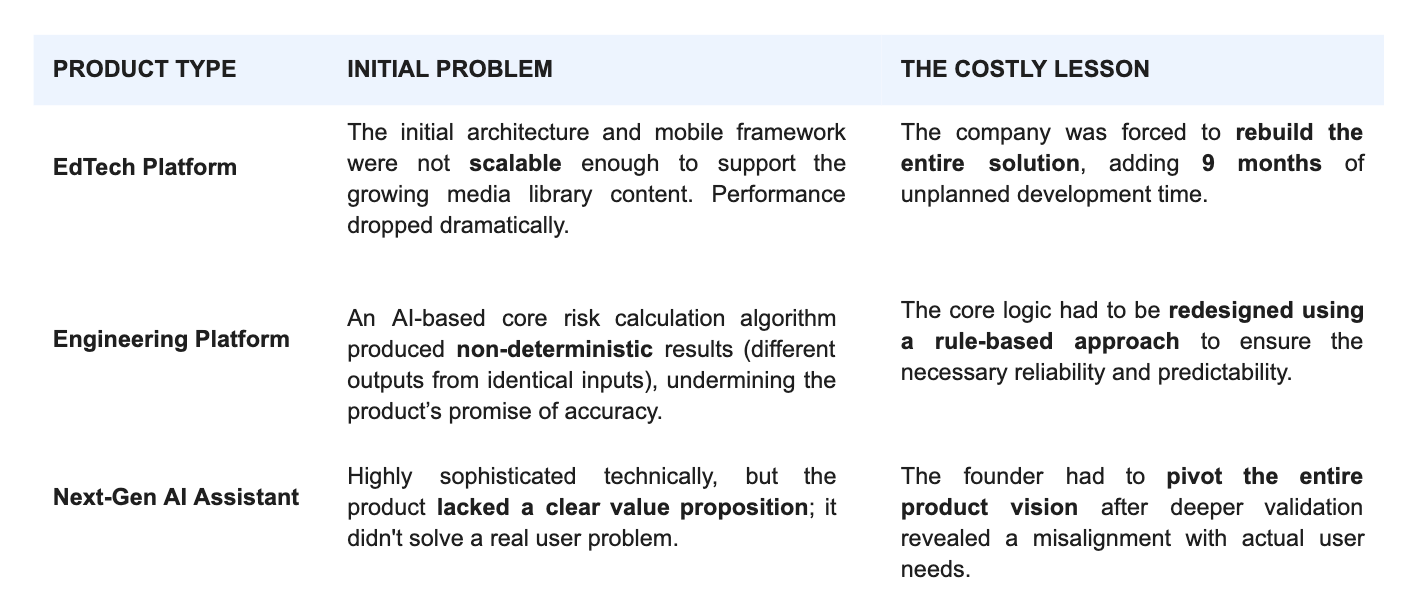
These scenarios showcase how early assumptions can dramatically impact a product’s trajectory. Based on years of hands on experience, HBM sees the same pitfalls repeatedly:
- Building without validating a real user need or product market fit
- Making wrong technical or AI decisions too early
- Weak collaboration between business and technical teams
- Underestimating complexity and delivery timelines
- Outsourcing without clear alignment
To ensure your product is built on a solid, scalable, and commercially viable foundation, we’ve outlined 5 practical tips built into a structured methodology.
Tip 1: Always Start with Product Discovery (Know What to Build)
Product Discovery is the first critical step in turning a raw idea into a validated product concept. It ensures you are solving a real problem for a real audience before any development begins.
- Understand your users: Conduct user interviews, market research, and competitor analysis to uncover motivations, pain points, and behaviors, and define your unique selling proposition and ideal customer profile.
- Validate product-market fit early: Test assumptions with clickable, high-fidelity prototypes and gather feedback to pivot quickly and cost-effectively.
- Align on clear outcomes: Create user personas, user journeys, a value proposition canvas, and a prioritized product roadmap focused on the MVP.
By investing upfront, teams avoid months of rework and gain shared clarity on the why, who, and what behind the product.
Tip 2: Define the Foundation with Technical Discovery (Know How to Build It)
Technical Discovery ensures your product can scale tomorrow by defining how it should be built once the product direction is clear. This phase establishes a foundation that is scalable, secure, and ready for growth.
- Assess feasibility and risk: Evaluate technical viability, integrations, data sources, and security or compliance requirements.
- Design the architecture: Define system components, interactions, infrastructure costs, and select the most suitable technology stack and frameworks.
- Create shared alignment: Use tools such as context diagrams and architecture inception canvases to capture business goals, key users, quality attributes like performance and security, and architectural assumptions.
The key outcome is a clear, well-documented architecture blueprint that minimizes technical risk and ensures the product works not only today, but also as it scales tomorrow.
Tip 3: Use AI only when it creates real value
AI is powerful, but it is not always the right solution. Using AI purely for marketing or investor appeal can increase costs, slow delivery, and overcomplicate MVPs.
-
- Validate the value first: Assess whether AI delivers measurable benefits such as automation, personalization, or insights. Evaluate data quality, costs, security constraints, and expected ROI.
- Choose simplicity when possible: In many cases, a rule-based or deterministic approach delivers more predictable and maintainable results than complex AI models.
- Select the right AI approach: When AI makes sense, choose the appropriate solution such as large language models, AI agents, or custom algorithms. Model selection should consider performance requirements, compliance needs, language support, deployment options including on-premise versus APIs, and overall cost structure.
Frameworks like the AI Business Model Canvas help align AI architecture decisions with concrete business outcomes, ensuring AI initiatives are sustainable rather than just innovative.
Tip 4. Alignment beats talent without direction
Even the best ideas fail without effective collaboration. Startups often underestimate how critical alignment is between founders, product leaders, and developers, especially when teams are distributed or partially outsourced.
- Keep key roles close to the vision: Product Manager and CTO roles should remain in-house whenever possible, as they own product strategy, technical feasibility, and long-term direction. Day-to-day execution and detailed requirements can be delegated to roles such as Product Owner or Software Architect.
- Align everyone on the big picture: Every team member should understand what is being built, why it matters, and what comes next.
- Establish clarity and transparency: Use tools like RACI matrices to define responsibilities, maintain a clear and prioritized backlog, and run regular communication rituals such as daily syncs, demos, and retrospectives.
Strong alignment and open communication build trust, reduce misunderstandings, and keep teams moving forward together.
Tip 5. Execution excellence is where strategy becomes reality
Execution is often the hardest part for startups, requiring a constant balance between speed and quality. Investor deadlines, pilots, and public launches frequently force trade-offs that must be managed deliberately.
- Execute pragmatically: Avoid overengineering early. When quality is sacrificed for speed, track technical debt explicitly in the backlog and plan dedicated time to address it later.
- Build in quality from day one: Even lean teams need strong engineering practices, including code reviews, testing, and documentation. AI code assistants can speed up prototyping, but maintainable systems still require senior engineering expertise.
- Use proven delivery practices: Apply agile methodologies, proper DevOps practices, and continuous integration and delivery to prevent deployment issues as the product scales.
- Track the right metrics: Monitor a small set of project and product metrics, such as sprint burndown and team velocity, to spot risks early and support teams before problems escalate.
Execution excellence ensures fast progress today without compromising the product’s ability to grow tomorrow.
Final thoughts
Great products do not happen by accident. They are the result of founders who invest in deep discovery, challenge assumptions, collaborate closely, and execute with discipline.
By avoiding common pitfalls such as rushing decisions, misapplying AI, or neglecting structured processes, startups save time, money, and frustration while significantly increasing their chances of building products that scale, perform, and truly solve user problems.
The takeaway is clear: slowing down early to think deeply is often the fastest path to long-term success.
To dive deeper into these five steps and see more real-world examples, access the full webinar replay, Building Tech Products Right: How to Avoid Costly Pitfalls, in our education library – free for our members.
Not a member yet? Explore our membership benefits and join the community that empowers Swiss startups.
Don’t miss out on the latest news and events. Subscribe to our newsletter and stay up to date.
News
Other, related articles you may like